Air Separation Units: FAQs to Help You Learn About It

1. What is an Air Separation Unit?
An Air Separation Unit (ASU), also called an Air Separation Plant, is basically an industrial facility that separates atmospheric air into its main components, which are:
- 78% nitrogen (N₂)
- 21% oxygen (O₂)
- 0.93% argon (Ar)
- Small quantities of carbon dioxide, neon, krypton, xenon and other gases
The process by which these air separation units work is called the cryogenic separation process, which, in simple terms, means that air is cooled to extremely low temperatures and then separated by distillation.
This process works because the gases in air (oxygen, nitrogen, argon and other trace gases) have different boiling points at a given pressure:
- Nitrogen: approximately −196°C
- Argon: approximately −186°C
- Oxygen: approximately −183°C
So, by controlling temperature and pressure, an air separation unit can separate these gases and produce them at the required purity, pressure and quantity.
2. How does an Air Separation Unit Work?
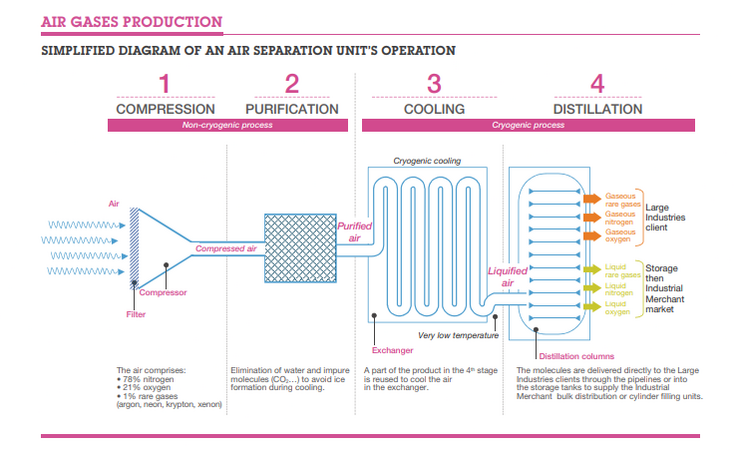
An air separation unit works through four main stages that include both non-cryogenic pretreatment and cryogenic separation:
Compression → Purification → Cooling → Distillation
Here’s a diagram of how an air separation unit operates, for visual learners:
Stage | Process |
|---|---|
1. Compression | Compression is one of the major energy-consuming parts of an air separation unit. The process starts with ambient air passing through a filter that removes dust and solid particles. It is then compressed to the required pressure using a compressor. |
2. Purification | After filtration and compression, the compressed air must be cleaned more thoroughly. Water vapor, carbon dioxide and other impurities are removed using adsorption systems, which are designed to cause molecules to adhere to a surface. The purification process is essential because water and carbon dioxide would solidify when exposed to cryogenic temperatures, forming ice or solid CO₂ inside the equipment and blocking the passages. After purification, the ASU has a clean and dry air stream that can safely enter the cryogenic section. |
3. Cooling | The purified air passes through a main heat exchanger, where it is cooled to extremely low temperatures and approaches liquefaction. Cold oxygen and nitrogen streams leaving the separation process pass back through the heat exchanger. As these products warm up, they help cool the incoming purified air. Part of the air may also be expanded through an expander to create additional refrigeration. So, rather than simply consuming refrigeration continuously, the ASU recovers and reuses much of the cold already generated within the process. |
4. Distillation | The cold and partially liquefied air then enters the distillation columns. Because nitrogen, argon and oxygen have different boiling points, they behave differently as the liquid and vapor move through the columns. Repeated cycles of evaporation and condensation gradually increase the concentration of each gas until the required purity is achieved. For oxygen specifically, many oxygen-producing ASUs use two interconnected columns operating at different pressures. A higher-pressure column begins the separation, while a lower-pressure column further refines the oxygen and nitrogen streams. Argon can also be withdrawn from the distillation system and sent through additional purification when argon production is required. |
But what happens after separation?
The finished products can leave the ASU either as gases or cryogenic liquids.
Gaseous oxygen and nitrogen can be supplied directly to nearby customers through pipelines.
Liquid oxygen, nitrogen and argon can be stored in insulated cryogenic tanks and later used for purposes such as:
- Being transported to other customers
- Being used for merchant distribution
- Being supplied to cylinder-filling facilities
- Being kept as emergency backup
3. What is an Air Separation Unit Used For?
Air separation units are a primary source of industrial and medical gases derived from atmospheric air. So, when industries require a reliable supply of oxygen, nitrogen, argon or other gases from air, particularly at large volumes or high purity, air separation units are here to help.
If you wish to learn more about the uses and benefits of each industrial gas, please refer to our industrial gases page, where you’ll find what you need.
4. What does an Air Separation Unit Look Like, and What are Its Main Components?
An ASU is a large, interconnected industrial system made up of compressors, purification equipment, heat exchangers, distillation columns, piping, storage systems and control equipment.
Here’s a 3D virtual tour of what Air Liquide’s separation unit typically looks like:
5. Are There Different Types of Air Separation Units?
Yes. ASUs can vary significantly depending on what gas is required, how much is needed, the required purity and pressure, and whether liquid production is necessary.
Here are some of Air Liquide’s air separation units types:
ASU Type | Details |
Sigma ASU | Sigma is a standardized cryogenic ASU designed for relatively compact installation and shorter construction schedules. Capacity: approximately 110–380 tonnes per day. Oxygen purity: up to approximately 99.8%. Co-products can include nitrogen, liquid oxygen, liquid nitrogen, liquid argon and compressed dry air. It is used in industries such as steel, chemicals, glass, non-ferrous metals, wastewater treatment, and pulp and paper. |
Yango™ | Yango is a larger standardized ASU solution. Capacity: approximately 330–770 tonnes per day. Oxygen purity: approximately 99.6–99.8%. Oxygen pressure: up to approximately 50 bar, depending on configuration. It is used in applications including steelmaking and chemical production. |
Large ASUs | Large custom-designed ASUs are intended for industries with very high and continuous gas demand. Individual units can reach approximately 6,000 tonnes per day, while multi-train ASU complexes can exceed 15,000 tonnes per day. They can produce oxygen, nitrogen, liquid oxygen, liquid nitrogen, liquid argon, compressed dry air and selected rare gases. These systems can be found in major steel, chemical, gasification and energy projects. |
APSA – Small Capacity Nitrogen Generation System | APSA is a smaller-capacity cryogenic nitrogen-generation system. Typical nitrogen production ranges from approximately 500 to 9,000 Nm³/h. It is used in applications such as LNG terminals, crude-oil refineries and electronics. |
TCN™-BE – Large Capacity Nitrogen Generation System | TCN-BE is designed for large-capacity, energy-efficient nitrogen production. Typical capacity is approximately 4,000 to 51,000 Nm³/h of nitrogen. It is used in electronics, chemicals, and oil and gas applications. |
Vacuum Swing Adsorption (VSA) – On-Demand Oxygen Generation | Vacuum Swing Adsorption, or VSA, is another air-separation technology, but it is different from a cryogenic ASU. VSA does not cool air to cryogenic temperatures. Instead, it uses special zeolite adsorbents that preferentially capture nitrogen, leaving an oxygen-rich product. Typical VSA oxygen purity is approximately 90–93%, compared with up to approximately 99.8% from some cryogenic ASUs. VSA is therefore suitable for applications where moderate oxygen purity and capacity are sufficient. |
6. What Air Separation Unit Size Does My Facility Need?
There is no single ASU size that is suitable for every facility. The correct size and configuration depend on several factors:
- Required flow
- Required purity
- Required pressure
- Required state (gas, liquid or both)
- Continuous or variable demand
- Backup requirements
- Available electrical or steam energy
- Energy cost
- Integration with the customer's process
- Available site space
- Capital and operating-cost priorities
For example, a facility requiring several tonnes of oxygen per day may be suited to a certain type of ASU, while a major steel or chemical complex could require a much larger system.
If you are feeling unsure, you can contact us and we will answer all your questions about air separation units
7. How does Air Liquide use Air Separation Units?
Air Liquide uses air-separation technology to produce and supply industrial gases for a wide range of industries and customer requirements.
We offer a wide range of industrial and medical gases through different supply modes that fit our customers’ needs and requirements.
- For large industrial customers, we install, operate and maintain on-site supply systems that provide our customers with a continuous and reliable gas supply of consistent quality.
- For customers who require more than 5,000 m³ of supply, our bulk supply options are designed to meet their needs through tank supply.
- For smaller quantities, we offer packaged gas supply through cylinders and dewars.
Whatever your needs are, we have the solution for you. Learn more about our supply modes to find out which ones best fit your needs.